Pantheon — AI Agent Orchestration Dashboard
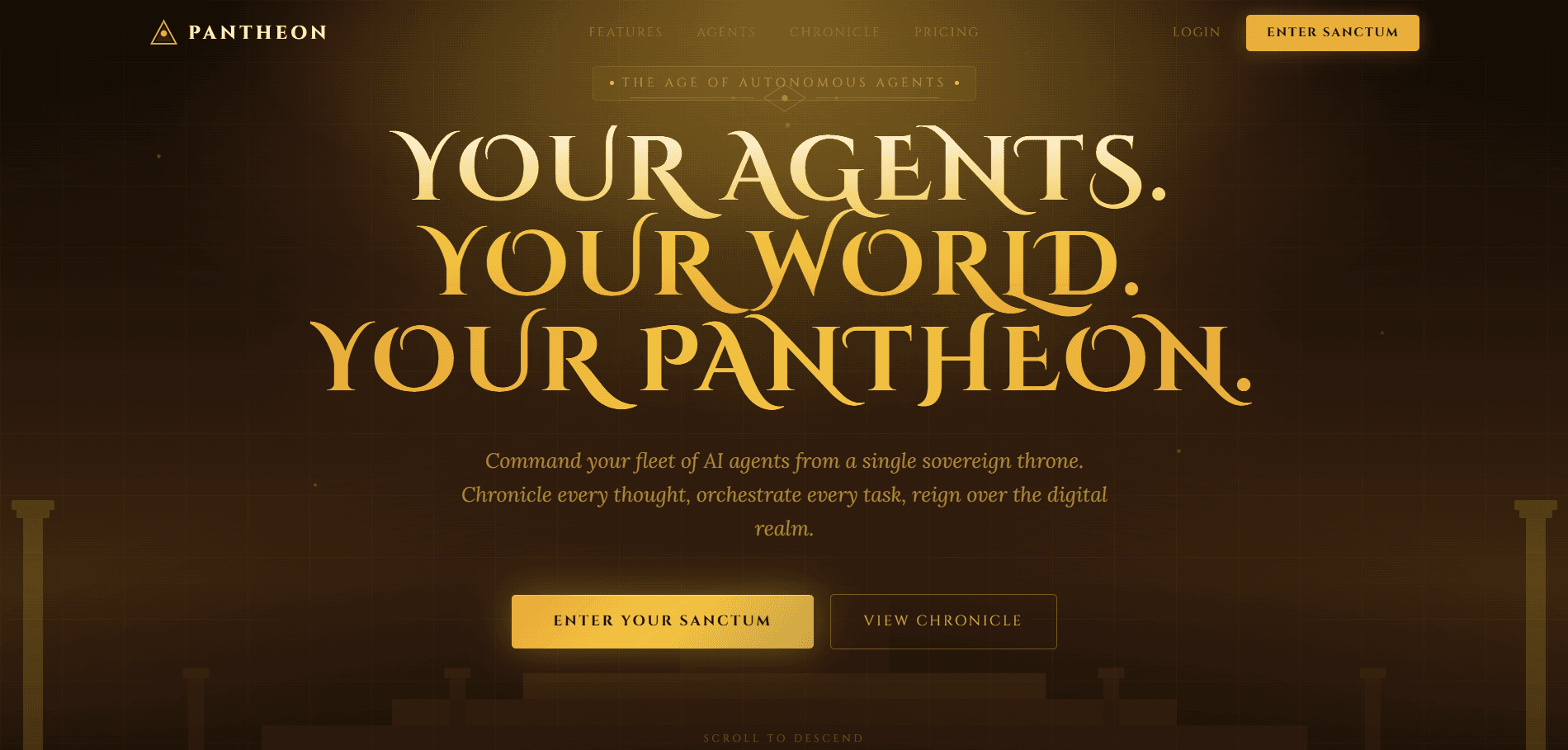
A full-stack web dashboard for orchestrating and monitoring AI agents deployed across remote VPS infrastructure, featuring real-time communication, RPG-themed UI, and SSH-tunneled CLI integration.
Gambaran Umum
Background
Managing a fleet of AI agents across multiple remote servers is inherently complex. Operators need to provision workflows, start and stop agents, monitor logs in real-time, run multi-step data pipelines, schedule cron jobs, and chat interactively with agents — all while maintaining secure SSH access to each VPS. The existing approach relied entirely on the **Hermes CLI** tool, which required direct terminal access to every server and deep command-line knowledge.
Pantheon was built to solve this by providing a **single, unified web interface** that abstracts the entire Hermes CLI surface behind a polished dashboard, enabling non-technical team members and operators to manage AI agent infrastructure without ever opening a terminal.
Solution
The core technical decision was to build a **Turborepo monorepo** with three packages:
@pantheon/web — A Next.js 16 front-end with React 19 and a fully custom RPG-themed design system
@pantheon/api — A Fastify 5 back-end that acts as a secure gateway between the web client and remote VPS servers via SSH
@pantheon/shared — Shared TypeScript types and utilities consumed by both apps
The API layer does not directly execute AI workloads. Instead, it maintains a persistent SSH connection pool to registered VPS servers and proxies every user action into a sanitized, whitelisted Hermes CLI command executed over the SSH tunnel. This architecture provides:
Security — The web client never has direct SSH access; all commands pass through a strict whitelist and input sanitizer
Reliability — SSH connections auto-reconnect with exponential backoff (up to 10 retries)
Performance — Connection pooling avoids the overhead of re-authenticating on every request
Real-time features (live logs, agent status polling, pipeline execution tracking, streaming chat) are powered by Socket.IO with JWT-authenticated namespaces, room-based subscriptions, and intelligent throttling.
Key Features
War Council Dashboard — A command-center overview displaying active agents in a grid, champions leaderboard, and real-time activity feed with quick-action shortcuts
Guild Hall (Workflow Manager) — Create, enable/disable, start/stop, and delete multi-agent workflows; each workflow acts as an isolated workspace for related agents
Champion Roster (Agent Manager) — Full lifecycle management for AI agents: add, configure, start, stop, schedule, and monitor with customizable avatar profiles and bios
Communion Chamber (AI Chat) — Real-time streaming chat with Hermes root agent or any specific workflow agent, with persistent session history and auto-resume via Hermes session IDs
Active Quests (Pipeline Runner) — Execute and monitor multi-step data pipelines with live step-by-step progress updates streamed via WebSocket
Oracle's Eye (Monitoring) — Live log viewer with log-level filtering (info/warn/error/debug) and VPS resource metrics (CPU, memory) polled at 30-second intervals with smart delta throttling
The Chronicle (Memory Manager) — Interface for managing agent long-term memory systems, including setup wizards and status monitoring
Spellbook (Skills Manager) — Install, update, and uninstall agent skill packs from registries or custom taps
Sacred Rituals (Cron Scheduler) — Create, edit, pause, resume, and trigger cron jobs with human-readable schedule visualization
Signal Towers (Gateway Control) — Install, start, stop, and manage the Hermes gateway service with user approval flows
Quest Board (Task Tracker) — Kanban-style task board with drag-and-drop, priority levels, agent assignment, and due-date tracking — all backed by Prisma
The Scriptorium (Docs Viewer) — Integrated documentation browser with search, sidebar navigation, and markdown rendering
Grand Grimoire (Configuration Editor) — Monaco-powered YAML configuration editor for Hermes config files
Sanctum's Form (Appearance Settings) — Theme customization including dark/light mode, accent colors, font families, glass effects, and custom background uploads
Security Layer — Helmet headers, CORS, rate limiting, request timeouts, JWT authentication with automatic refresh, command whitelisting, and SSH host fingerprint verification
Technical Highlights
Monorepo with Turborepo — Parallel builds, shared TypeScript config, and unified dev command across all packages
SSH Connection Pooling — Persistent connections with automatic reconnection (exponential backoff up to 30s) and fingerprint verification for TOFU-style host key management
Command Whitelisting — Every SSH command is validated against a strict whitelist before execution to prevent injection attacks
Real-time Architecture — Six distinct WebSocket channels: agent status, live logs, pipeline execution, VPS metrics, chat streaming, and push notifications
Token Auto-Refresh — API client transparently intercepts 401 responses, refreshes the JWT via httpOnly cookie, and retries the original request
Type-safe API Layer — Full Zod validation on all request/response schemas shared between client and server
Graceful Shutdown — PTY sessions closed, SSH connections drained, and Prisma disconnected on SIGTERM
Accessible Navigation — Skip-to-content link, ARIA labels, keyboard-navigable sidebar, and tooltip fallbacks for collapsed state
Results
Built a production-ready dashboard with 24+ pages covering the entire Hermes CLI surface
Achieved a fully type-safe monorepo across client, server, and shared packages with zero `any` types
Enabled non-technical operators to manage AI agent infrastructure without terminal access
Delivered a real-time monitoring experience with sub-second log streaming and 30-second metric polling
Created a distinctive visual identity with the Parchment RPG theme that doubles as a design system showcase
Peran & Tanggung Jawab
Solo Full Stack Developer